Chicago, United States
News Desk | World Affairs
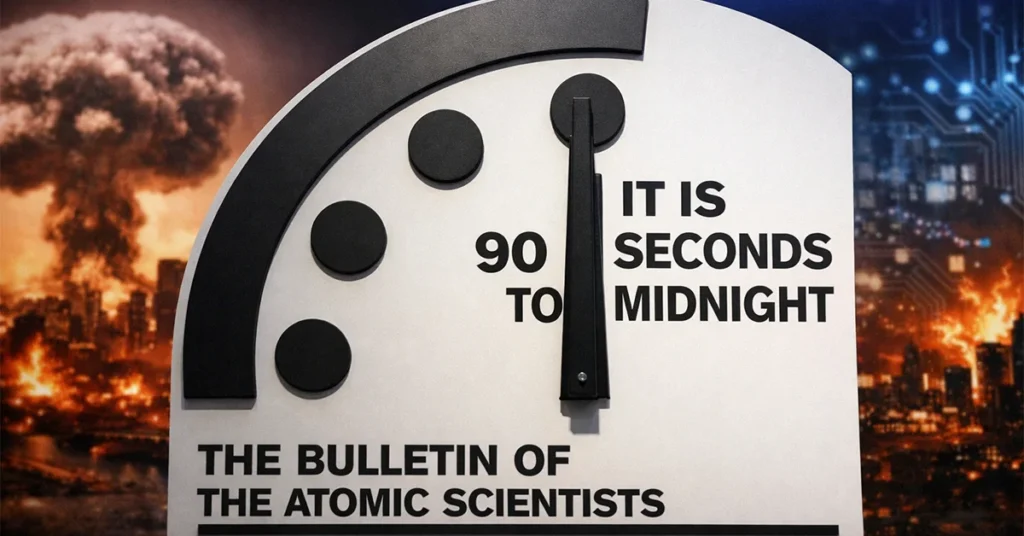
The midnight doomsday clock remains set at 90 seconds to midnight, the closest point to symbolic global catastrophe, according to the Bulletin of the Atomic Scientists, which announced its annual assessment on Tuesday. The decision reflects continued concerns over nuclear threats, climate change, geopolitical conflicts, and the rapid expansion of artificial intelligence technologies.
The Bulletin said the midnight doomsday clock was left unchanged because global conditions have not improved since the setting was moved forward in 2023. Experts cited the war in Ukraine, heightened tensions involving nuclear-armed states, and the erosion of arms control agreements as key factors influencing the decision.
Rachel Bronson, president and CEO of the Bulletin, said in a statement that humanity is “closer than ever” to catastrophic risk due to the inability of world leaders to cooperate on reducing existential threats. She noted that nuclear saber-rattling and military modernization programs continue without sufficient safeguards.
Climate change was also identified as a major driver behind the midnight doomsday clock’s position. The Bulletin said current national commitments to reduce emissions fall short of preventing severe environmental disruption, increasing global instability and humanitarian pressure.
The organization further warned that artificial intelligence is being deployed in military and strategic contexts faster than international rules can be established. According to the Science and Security Board, this raises the risk of misjudgment or unintended escalation during crises.
First introduced in 1947, the midnight doomsday clock is a symbolic measure intended to communicate the level of global danger based on expert evaluation, not to predict specific events. The Bulletin emphasized that moving the clock back would require measurable progress on arms control, climate action, and international cooperation.
The Bulletin said it will continue monitoring developments and reassess the midnight doomsday clock as conditions evolve. The story is developing.
ALSO READ: Challenger Explosion Kills Seven After Shuttle Breaks Apart During Launch