New York, United States
News Desk | Business
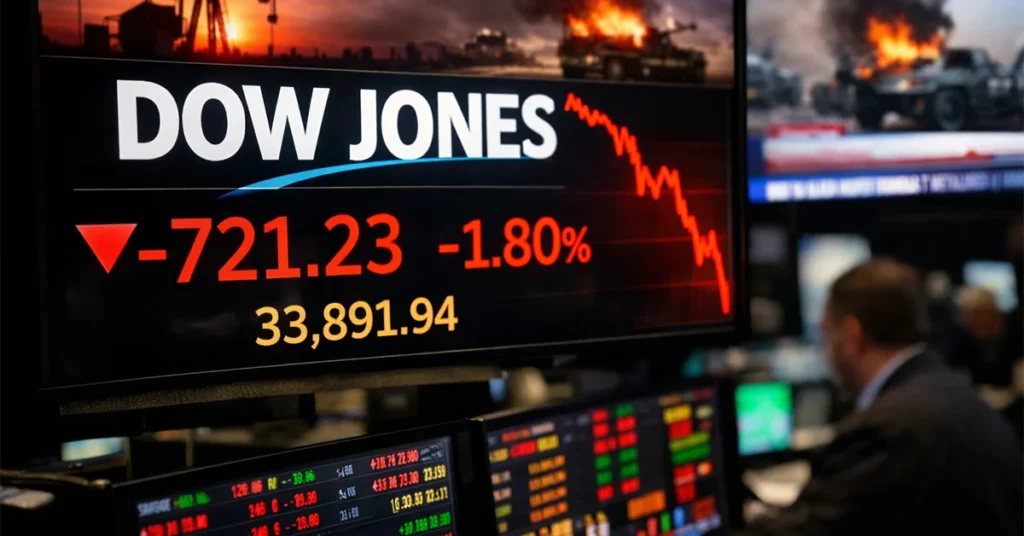
New York, United States — The Dow Jones Industrial Average fell sharply Monday as rising oil prices and escalating geopolitical tensions unsettled global financial markets, sending major U.S. indexes lower and increasing investor concerns about inflation and economic growth. The sell-off followed a surge in crude prices linked to conflict in the Middle East and potential disruptions to global energy supplies.
The Dow Jones dropped more than 700 points, or roughly 1.5%, during trading, while the S&P 500 and Nasdaq Composite also declined, according to market data reported by multiple outlets. Investors reacted to crude oil briefly climbing toward $120 per barrel, its highest level since 2022, amid fears that instability could affect shipments through the Strait of Hormuz, a critical route for global oil supply.
Energy price shocks and geopolitical uncertainty weighed heavily on sectors sensitive to fuel costs and economic activity. Airline and cruise companies posted some of the steepest losses, while banking shares and travel-related stocks also declined as investors reassessed growth expectations.
Market volatility rose as investors shifted toward safer assets such as the U.S. dollar. Analysts said surging oil prices could complicate efforts by central banks to curb inflation, particularly in the United States where fuel costs feed directly into consumer prices.
Some economists warned that prolonged energy disruptions could create conditions resembling stagflation — a combination of slower economic growth and persistent inflation — which has historically posed challenges for policymakers and financial markets.
The sell-off also followed recent signs of weakness in U.S. economic data, including softer labor market indicators that have added to uncertainty about the Federal Reserve’s timeline for potential interest-rate cuts.
The Dow Jones, which tracks 30 major U.S. companies across multiple industries, is widely viewed as a barometer of investor sentiment and the broader health of the American economy. The index reached a historic milestone in February when it briefly closed above 50,000 points for the first time.
Market participants are now closely monitoring energy prices, geopolitical developments, and upcoming economic data for signals on the direction of global markets.
ALSO READ: Celtics Vs Cavaliers: Boston And Cleveland Battle In Key Eastern Conference Showdown